
MPC vs Multisig: what actually differs
The short answer, up front
Multisig puts several complete keys on-chain and the blockchain enforces the quorum; MPC splits one key into shares that jointly compute a single signature off-chain. Multisig is transparent but chain-specific and reveals your policy on-chain. MPC produces a standard signature on any chain and keeps the quorum private.
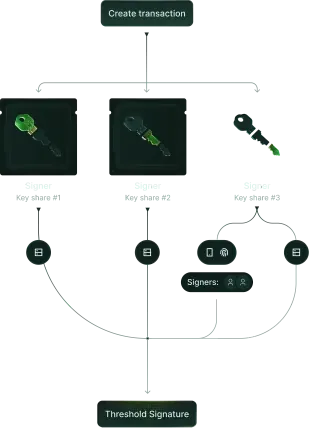
How each works
A smart contract or script address requires M of N complete private keys to sign. Every signer holds a whole key; the chain validates the quorum and everyone can see it.
One key exists only as distributed shares. Parties run a cryptographic protocol to produce one ordinary signature — no share ever becomes a key, nothing special appears on-chain.
Multisig support varies per chain (native on Bitcoin, contract-based on Ethereum, absent elsewhere); MPC works identically on every chain because the output is a normal signature.
MPC vs multisig, point by point
| Multisig | MPC | |
|---|---|---|
| Where the quorum lives | On-chain — visible to everyone | Off-chain — private |
| Chain coverage | Per-chain implementations, uneven | Any chain; the signature is standard |
| Key material | N complete keys exist | No complete key ever exists |
| Fees | Higher on contract chains (multisig contract calls) | Normal single-signature fees |
| Policy changes | On-chain transaction (visible, costs gas) | Off-chain reshare — addresses unchanged |
Why institutions moved to MPC
Three reasons dominate: uniform coverage across chains that have no native multisig; privacy of the signing policy; and operational flexibility — thresholds change by ceremony, not by migrating funds to a new address. The trade-off is trust in the MPC implementation itself, which is why protocol choice (e.g. DKLS23, FROST) and an auditable recovery path matter when evaluating vendors.
MPC and multisig, side by side
The differences that actually change an operating model.
Share the Trust Guard the Keys
Read the topology, then run one on testnet — it settles the argument faster than a table.