
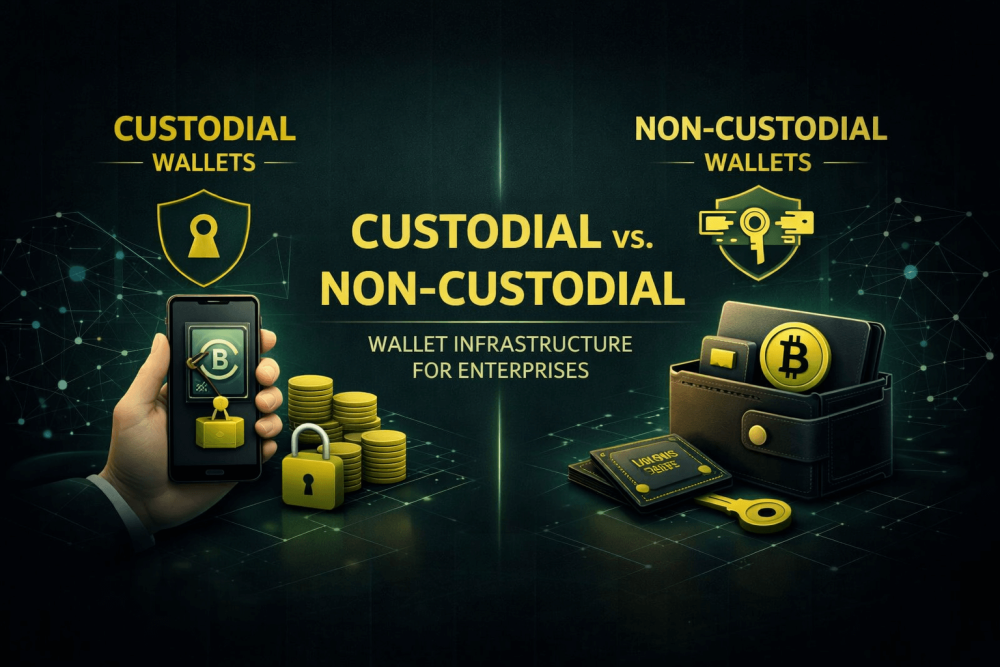
As digital assets become a core part of enterprise finance, treasury operations, and fintech platforms, organizations must make a foundational infrastructure decision: how digital asset control is structured within the organization.
This decision is typically framed as custodial vs non-custodial wallet infrastructure. While often discussed in technical terms, it is ultimately a business decision with direct impact on enterprise risk management, regulatory posture, operational resilience, and long-term scalability.
For CFOs, treasury teams, compliance leaders, and fintech decision-makers, understanding enterprise crypto custody models is now a prerequisite for operating securely in digital asset markets.
Custodial Wallet Infrastructure in Enterprise Environments
Custodial wallet infrastructure is a model where a third-party provider operates the systems responsible for authorizing and executing digital asset transactions on behalf of an organization. This approach has long been common in institutional digital asset custody, particularly among exchanges, payment platforms, and early-stage enterprise crypto programs.
Advantages of custodial wallet infrastructure
For many enterprises, custodial crypto custody solutions offer meaningful benefits:
- Operational efficiency: Organizations outsource signing operations, security management, and infrastructure maintenance.
- Faster deployment: Custodial providers reduce time-to-market for new digital asset initiatives.
- Lower internal complexity: Internal teams are not required to operate blockchain security infrastructure.
- Established workflows: Custodial models are familiar to regulators and financial stakeholders in many jurisdictions.
These characteristics make custodial wallet infrastructure attractive for enterprises prioritizing speed, simplicity, or high-volume transaction processing.
Trade-offs of custodial infrastructure
At the same time, custodial models introduce constraints that enterprises must carefully evaluate:
- Counterparty dependency: Asset movement depends on the custodian’s operational availability.
- Shared security exposure: Incidents affecting the custodian can impact multiple organizations simultaneously.
- Governance limitations: Enterprises may have limited ability to customize approval workflows or transaction policies.
- Regulatory spillover risk: Custodians operate under strict regulatory frameworks that can influence customer operations.
For organizations managing significant digital asset exposure, these factors become increasingly relevant as asset volumes grow.
Non-Custodial Wallet Infrastructure for Enterprises
Non-custodial wallet infrastructure takes a different approach to enterprise digital asset custody. Instead of relying on a single operator to authorize transactions, control is enforced through distributed authorization and governance mechanisms.
Modern non-custodial wallet infrastructure for enterprises is typically built using MPC (Multi-Party Computation). From a business perspective, MPC can be understood as a system where:
- Transaction approval requires participation from multiple independent components.
- No single system, person, or service can act alone.
- Governance rules are enforced automatically during transaction execution.
This architecture allows enterprises to retain direct control over digital asset operations while still using professional, enterprise-grade wallet infrastructure.
Benefits of Non-Custodial Wallet Infrastructure
For many organizations, non-custodial crypto custody offers advantages aligned with enterprise governance and risk frameworks:
- Greater operational control: Transaction execution requires internal participation, not just external approval.
- Reduced single-point risk: Compromising one system is insufficient to move assets.
- Stronger internal controls: Multi-approval workflows, thresholds, and escalation policies are built into the infrastructure.
- Clear separation of responsibilities: Infrastructure providers enable operations without unilaterally controlling them.
These characteristics make non-custodial wallet infrastructure increasingly attractive for crypto treasury management, fintech platforms, and digital asset service providers operating at scale.
Considerations with non-custodial models
Non-custodial infrastructure also requires thoughtful implementation:
- Governance ownership: Enterprises must define approval policies and operational roles.
- Process maturity: Teams need clear procedures for approvals and exception handling.
- Not one-size-fits-all: Some use cases may not require the additional control provided by non-custodial models.
As with any enterprise blockchain infrastructure decision, alignment with business objectives is critical.
Custodial vs Non-Custodial: How Enterprises Should Evaluate
When comparing custodial and non-custodial wallet infrastructure, enterprises should focus on a few core questions:
- How critical are digital assets to the balance sheet?
- What level of internal governance is required?
- How much operational dependency on third parties is acceptable?
- How important is long-term flexibility in custody architecture?
Custodial models tend to emphasize convenience and outsourcing.
Non-custodial models emphasize control, resilience, and governance.
Neither approach is inherently superior. However, as enterprise adoption of digital assets deepens, non-custodial infrastructure is increasingly viewed as a strategic advantage rather than a technical preference.
MPC Wallet Infrastructure, Simplified
MPC wallet infrastructure is often described as complex, but its enterprise value is straightforward. It acts as a technical enforcement layer for business approvals.
Instead of relying on a single system to authorize transactions:
- Multiple participants must cooperate.
- Approval logic is embedded directly into transaction execution.
- Auditability and policy enforcement are native to the workflow.
For enterprises already operating under segregation-of-duties and multi-approval requirements, MPC-based non-custodial infrastructure aligns naturally with existing controls.
Vaultody’s Enterprise Non-Custodial Positioning
Vaultody is a B2B SaaS platform focused on non-custodial wallet infrastructure for enterprises.
Vaultody’s solutions support organizations that require:
- Enterprise-grade MPC wallet infrastructure
- Policy-driven approvals and transaction controls
- Scalable digital asset custody without surrendering operational authority
- Clear audit trails and governance visibility
By focusing on non-custodial architecture, Vaultody aligns with enterprises that prioritize control, resilience, and long-term operational integrity in their digital asset custody solutions.
Choosing the Right Enterprise Crypto Custody Model
Selecting between custodial and non-custodial wallet infrastructure is a strategic decision. It should reflect:
- Risk tolerance and regulatory context
- Transaction volume and operational complexity
- Internal governance maturity
- The long-term role of digital assets in the organization
Custodial infrastructure continues to serve valid enterprise use cases. At the same time, enterprise non-custodial wallet infrastructure has matured into a viable, scalable, and governance-friendly option.
For organizations building durable digital asset operations, understanding this distinction is no longer optional. It is foundational to enterprise blockchain security and digital asset strategy.






 Copy link