Enterprises evaluating wallet infrastructure are no longer just asking how quickly wallets can be deployed. They are asking harder questions about control, responsibility, and long-term risk - especially when end users, regulators, and internal security teams scrutinize who can actually access digital assets.
This is where many Wallet-as-a-Service implementations fall short.
A solution can use modern cryptography and still behave like custody. It can support embedded wallet experiences and still leave the platform operator with the ability to authorize transactions. In many cases, “self-custody” is more a positioning statement than a provable architectural property.
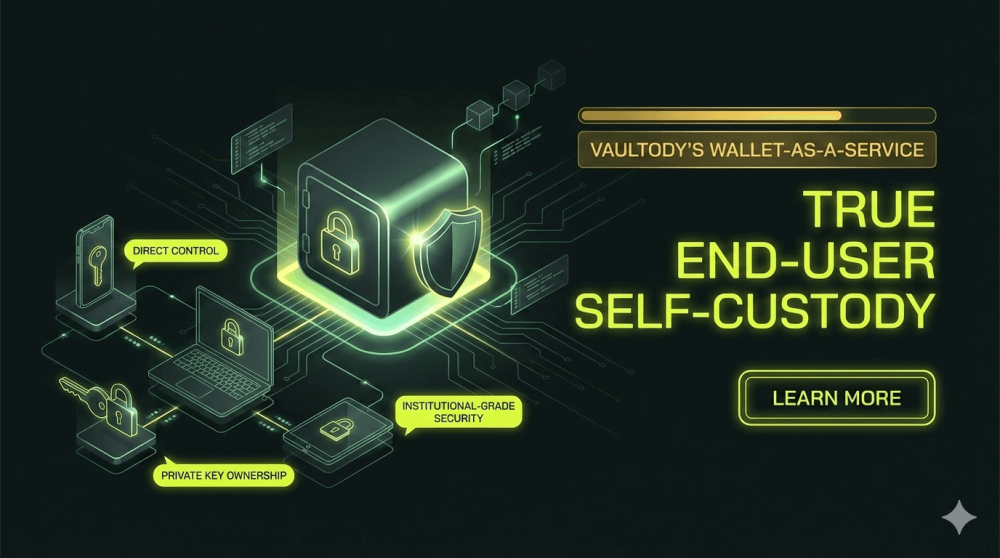
Vaultody’s Wallet-as-a-Service is built around a stricter, enterprise-grade definition: the end user is the custodian of their assets, while the platform integrates wallet infrastructure without ever gaining control over user funds.
Wallet-as-a-Service Is Ultimately a Custody Model Decision
When enterprises assess wallet infrastructure, the real challenge is not wallet creation or blockchain connectivity. The challenge is enabling secure, scalable wallet functionality without inheriting the responsibilities and liabilities of custody.
Behind the scenes, wallet infrastructure can follow very different control models:
- Custodial architectures where the platform or its infrastructure provider can authorize transactions.
- Hybrid or pseudo-custodial designs where cryptography is advanced, but operational control still sits with the business.
- End-user self-custody models where authority to move assets remains exclusively with the user.
Only the last option fully separates product experience from asset control. That separation is increasingly important for organizations operating across jurisdictions, managing compliance risk, or serving users who demand clear ownership guarantees.
Vaultody’s Wallet-as-a-Service is designed specifically for this third model.
True End-User Self-Custody vs Custodial and Pseudo-Custodial Wallet Infrastructure
A simple test exposes the difference between true self-custody and everything else:
Can the platform operator, or the infrastructure provider, move user funds without the user’s involvement?
If the answer is yes - even in exceptional scenarios - then custody responsibility still exists within the organization.
That reality carries consequences:
- Greater regulatory ambiguity around who safeguards assets
- Expanded liability if signing processes are compromised
- Higher trust requirements placed on the platform rather than on cryptographic guarantees
Vaultody’s Wallet-as-a-Service avoids these outcomes by ensuring that custody authority never leaves the end user, by design.
End User as the Custodian of Assets
At the core of Vaultody’s WaaS is a clear custody boundary:
- End users retain private key ownership.
- End users remain the custodians of their assets.
- The platform operator does not hold keys.
- Vaultody does not hold keys.
This separation allows businesses to embed wallet functionality directly into their products while remaining non-custodial. The organization delivers the user experience, lifecycle management, and support workflows, while Vaultody provides the underlying wallet infrastructure.
For enterprise teams, this distinction simplifies internal alignment between legal, compliance, security, and product teams. Custody responsibility is explicit and enforceable at the architectural level.
MPC Threshold Signing With Distributed Key Shares
Vaultody’s Wallet-as-a-Service is built on MPC threshold signing, but the critical detail lies in how that technology is implemented.
Instead of storing a private key in a single location, cryptographic control is split into multiple protected key shares. Transactions can only be authorized when a defined threshold of these shares participates in signing.
This design achieves several outcomes simultaneously:
- No single component can sign transactions independently.
- Private keys are never reconstructed.
- There is no single point of compromise that can result in asset loss.
Vaultody combines this security model with enterprise-ready APIs, SDKs, and multi-chain support, allowing businesses to deploy wallets without building cryptographic systems from scratch.
Why Neither the Platform Nor Vaultody Can Control User Funds
True self-custody only exists if control is technically impossible for unauthorized parties - not just discouraged by policy.
Vaultody’s architecture enforces this through:
- Threshold-based signing that requires multiple participants
- Distributed key shares that prevent unilateral control
- Signing workflows that inherently involve the end user
As a result, neither the integrating platform nor Vaultody can independently authorize transactions or move user funds. Operational oversight, monitoring, and support are possible, but asset control remains exclusively with the user.
For enterprises, this creates a cleaner boundary between infrastructure management and asset ownership.
Business Benefits: Regulatory Clarity, Reduced Liability, Stronger Trust
Choosing true end-user self-custody has direct business implications beyond security.
Regulatory clarity
When users retain private key ownership and custody, organizations can more clearly articulate their role as technology providers rather than asset custodians. This distinction supports more consistent regulatory interpretations across markets.
Reduced liability exposure
Removing unilateral control over funds reduces the impact of internal errors, credential misuse, or infrastructure breaches. The organization’s risk profile shifts away from custody failure toward infrastructure resilience.
Stronger customer trust
Users increasingly understand the difference between having an account and having control. A wallet architecture that guarantees user custody supports trust at scale and avoids difficult conversations later as products grow.
How to Evaluate Wallet-as-a-Service for Self-Custody
When comparing Wallet-as-a-Service solutions, enterprises should push for architectural clarity with questions such as:
- Who is the legal and technical custodian of user assets?
- Can any single party authorize transactions on its own?
- Are keys ever reconstructed during signing or recovery?
- Is self-custody enforced by cryptography or by policy?
- Does the platform still support enterprise monitoring, APIs, and operational visibility?
Vaultody’s Wallet-as-a-Service is designed to answer these questions directly. It delivers enterprise-grade wallet infrastructure while preserving end-user custody through MPC threshold signing and distributed key ownership.
For organizations that want to scale wallet functionality without becoming custodians, that distinction is not a detail. It is the foundation.






 Copy link