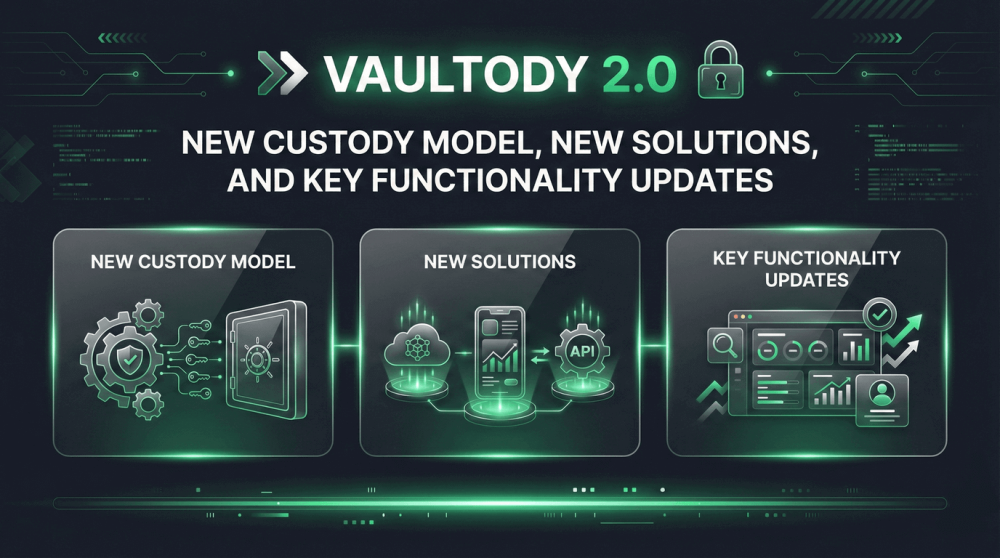
As digital assets become integral to financial operations, enterprises require custody infrastructure that can scale with organizational complexity, support diverse use cases, and enforce rigorous governance. Traditional wallet tools do not satisfy these demands. Institutions now look for solutions that combine self-custody, policy-driven controls, workflow automation, and robust MPC-based security.
Vaultody 2.0 meets these needs. It represents a major evolution from the current Vaultody platform, introducing a redesigned architecture, new operational capabilities, and a clearly defined suite of enterprise solutions. Built on a fully non-custodial framework with distributed MPC signing, Vaultody 2.0 provides organizations with full control over their assets while delivering the infrastructure necessary to operate securely at scale.
This article outlines the key advancements introduced with Vaultody 2.0 and how they improve upon the existing platform.
A Platform Rebuilt Around Enterprise Requirements
While the existing Vaultody environment delivers secure MPC custody tooling, Vaultody 2.0 refines and expands it into a unified platform designed for large internal treasuries, B2B digital asset platforms, and high-growth fintech ecosystems.
The transition begins with a fully non-custodial operating model. Enterprises remain custodians of their own assets or, in the case of certain solutions, the custodians of end-customer assets. Vaultody supplies the MPC infrastructure, governance layer, and operational framework that enable secure and compliant digital asset operations.
This shift ensures greater separation of duties, reduced dependency on predefined vault types, and a platform structure that aligns with institutional requirements for transparency and operational clarity.
A Refined Segregation Model for Clear Asset Organization
Vaultody 2.0 introduces a standardized and intuitive segregation model:
Vault -> Vault Account -> Asset -> Address
This replaces the vault-type structure of the current platform and enables organizations to create any number of vault accounts to represent business units, customer groups, managed portfolios, or operational categories.
The enhanced segregation model improves auditability, simplifies reporting, and supports organizations managing large-scale asset structures across multiple teams or product lines.
Address-Level Fee Management
In the current platform, the Gas Tanker relies on a stationary address to cover transaction fees. In Vaultody 2.0, this model evolves significantly. Every address within your Vault can now pay network fees directly in the native asset, removing the dependency on a single fee-funding address. This change simplifies fee handling, reduces operational overhead, and makes batch transactions more efficient and predictable across all supported blockchains. It also supports both strategic treasury transactions and high-volume, API-driven operations.
Enhanced UTXO Management
Vaultody 2.0 provides improved UTXO management, enabling organizations to select and spend specific UTXOs when transacting on Bitcoin and other UTXO-based networks.
UTXO-level control supports fee optimization, reduces dust, enhances clarity of fund movements, and gives teams more predictable control over Bitcoin transaction composition.
Transition From Smart Vaults to Workflow-Based Automations
Smart Vaults and the legacy automation vaults are entering the end of life in Vaultody 2.0. They are replaced with a new, more extensive automation framework.
Instead of vault-type-specific automation, Vaultody 2.0 delivers workflow automations that execute tasks when defined events occur. These workflows allow organizations to automate operational processes such as:
- Conditional sweeping between vault accounts
- Automated routing of new deposits
- Multi-step internal treasury actions
- Escalation or notification workflows triggered by specific events
This shift gives enterprises greater flexibility than Smart Vaults, allowing automation to be configured around internal policies, compliance requirements, and operational procedures rather than relying on predefined vault categories.
Automations will be introduced in early 2026 as part of the Vaultody 2.0 rollout.
Flexible Co-signer Options for Governance Alignment
Vaultody 2.0 introduces two co-signer types operating within the MPC framework, giving organizations flexible approval paths that reflect their internal governance requirements:
• Server Co-Signer
Designed for high-frequency, API-driven environments. The server co-signer automatically evaluates transactions against your policy rules, thresholds, and escalation logic. When activity falls within predefined limits, it co-signs instantly, supporting high-volume trading, payment flows, and real-time settlement without manual intervention.
• Mobile MPC Signer
A secure, mobile-based signing path used for sensitive or high-value approvals. When a transaction exceeds policy thresholds or requires human oversight, authorized team members receive a mobile approval request. This ensures that strategic transfers, treasury movements, or escalated end-user withdrawals are reviewed and signed with full accountability.
How Enterprises Use This in Practice
With both signing paths available, organizations can orchestrate workflows that balance speed with governance. For example:
- A trading desk can process hundreds of in-range transfers automatically through the server co-signer, while large portfolio reallocations require a mobile-based human signature.
- A payment platform can automate daily user withdrawals under a certain value, escalating only unusual or above-limit activity to senior operators for mobile approval.
- A corporate treasury can route routine internal transfers through automated policies, while sending strategic movements, such as staking allocations, funding cycles, or vendor payments, to executive approvers on mobile.
Together, the server co-signer and Mobile MPC Signer provide a unified architecture with no single point of failure, ensuring operational efficiency without compromising governance, oversight, or security.
Simplified Transaction Flow
Transactions in Vaultody 2.0 are executed at the asset level, streamlining blockchain operations and reducing the steps required for multi-chain activity. This creates a consistent, chain-agnostic workflow while the platform handles blockchain-specific logic internally.
Enterprises benefit from more predictable execution paths and reduced operational complexity.
A More Complete Solutions Portfolio
Vaultody 2.0 introduces a structured set of enterprise solutions designed around real operational models:
Treasury Management Solution
Built for organizations managing their own digital assets. It supports MPC signing, multi-chain visibility, approval workflows, and structured account hierarchies suitable for internal treasuries, trading desks, hedge funds, and asset managers.
Direct Custody Solution
Developed for exchanges, wallet providers, payment institutions, and fintech ecosystems managing assets on behalf of business customers or end users. It provides segregated accounts, high-volume API-driven operations, and rule-based co-signer logic, all under a non-custodial architecture.
Wallet-as-a-Service Solution
Designed for platforms offering self-custody wallets to end users at scale. Each user receives an MPC vault, and organizations integrate through APIs, SDKs, and onboarding tools, supported by enterprise oversight dashboards.
Coming Soon
Two additional platforms expand the enterprise offering:
- Tokenization Platform, supporting multi-chain asset issuance and governance
- Stablecoin Operations Platform, enabling payment acceptance and multi-chain settlement flows
These additions position Vaultody not only as a custody infrastructure provider, but as a complete digital asset operations platform.
New Dashboard and Updated Pricing
A new dashboard will launch in Q1 2026, introducing improved visibility, streamlined administration, and more granular governance controls across all solutions.
Alongside the dashboard release, Vaultody will introduce a new pricing structure aligned with the capabilities and scope of Vaultody 2.0. The new pricing model will reflect expanded solutions, added infrastructure, and advanced governance, offering a more transparent and scalable framework for enterprise customers.
Conclusion
Vaultody 2.0 represents a comprehensive overhaul of the existing platform, reflecting the maturity of the digital asset ecosystem and the needs of enterprise customers. With enhanced segregation, workflow-based automation, improved governance, flexible co-signer paths, and a refined solutions portfolio, Vaultody 2.0 provides organizations with a framework built for scale, security, and operational clarity.
By moving away from legacy vault types and introducing a unified platform architecture, Vaultody 2.0 positions enterprises for efficient, compliant, and future-ready digital asset operations.






 Copy link